

We often speak about change as if it starts with a big decision. In our experience, it usually starts with a small question. Why did we react that way? What are we not seeing yet? What else could be true?
Curiosity is not childish distraction. It is disciplined openness. It helps us interrupt automatic reactions, notice hidden patterns, and give fresh meaning to familiar situations. Curiosity creates space between impulse and understanding.
Many people think curiosity appears on its own, only when life feels new or exciting. We see it differently. Curiosity can be trained. Like attention, it grows when we practice it in daily life, in ordinary moments, with honest observation and steady effort.
That matters because curiosity is tied to well-being in lasting ways. Findings shared in research on becoming a more curious person connect curiosity with greater life satisfaction, stronger relationships, better work outcomes, and even longer life. This tells us something simple. Curiosity is not extra. It shapes how we live.
Why curiosity gets blocked
Most of us are not lacking intelligence. We are crowded by haste, certainty, and emotional fatigue. We move through the day repeating conclusions we reached long ago. Then we stop noticing.
We have seen this in small scenes. A person hears feedback and defends before listening. Another has the same argument every week, only with new details. Someone walks the same route, sees the same people, and feels nothing new can happen there.
Routine can close perception.
Curiosity weakens when we confuse familiarity with truth. It also weakens when we feel threatened. If every question seems to put our identity at risk, we protect ourselves by becoming rigid. That is why mature curiosity is gentle but brave. It asks without attacking. It observes without rushing to judge.
If you want to deepen this kind of inner work, themes related to self-knowledge help us see where our fixed stories began.
Simple daily exercises that open perception
The best curiosity exercises are not dramatic. They are short, clear, and repeatable. We do not need to change our whole schedule. We need to relate to our experience with more presence.
Start the day with one live question
Choose one question in the morning and carry it through the day. Not a question you can answer in one minute, but one that keeps attention awake.
Examples can help:
What tends to trigger my tension today?
When do I feel most open in conversation?
What am I assuming without checking?
This works because the mind begins to scan reality differently. We stop looking only for proof of what we already believe. We start noticing movement, contradiction, and detail.
A good question can organize a whole day of awareness.
Use the three-note method
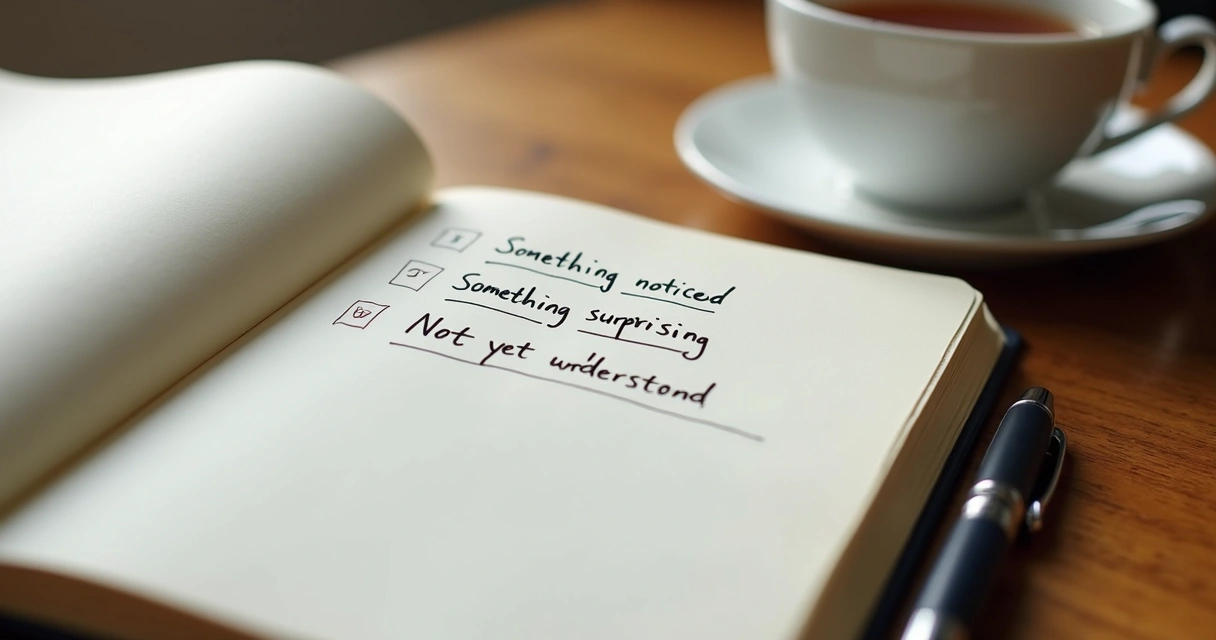
Keep one place for brief notes on your phone or in a notebook. At the end of the day, write only three lines:
Something I noticed.
Something that surprised me.
Something I still do not understand.
We like this exercise because it is light, but it still builds reflective strength. Over time, these notes reveal repeating themes. They also train us to respect uncertainty instead of hiding it.
Change one ordinary pattern
Take one routine action and do it differently. Sit in a new place during lunch. Take a different street. Ask a new kind of question in a familiar meeting. Pause before answering a message that usually gets a fast reaction.
New insights often come from altered context, not from harder thinking. When the pattern shifts, perception shifts too.
For readers interested in long-term personal adaptation, our themes on systemic change can support this kind of practical reorganization.
Curiosity in relationships
Some of the strongest blind spots appear between people. We think we know what the other person means, so we stop listening. Then conflict becomes mechanical.
One useful daily exercise is the delayed conclusion. In one conversation each day, wait a little longer before deciding what the other person is trying to say. Ask one more question than usual. For example:
What led you to that view?
What part of this feels hardest for you?
What do you wish I understood better?
This is not passive agreement. It is active inquiry. It can soften defensiveness and reveal the structure beneath the words.
There is also evidence that curiosity grows through contact. A study on how curiosity can spread through social influence suggests that being exposed to curious people can raise our own curiosity. We become more open by spending time with those who ask real questions, tolerate nuance, and stay present with the unknown.
That is one reason conversations matter so much. They shape the climate of the mind.
Working with emotional resistance
Not every answer appears because we ask well. Sometimes we ask, but a feeling closes the door. Shame, fear, pride, and frustration can all stop honest seeing. When that happens, curiosity must turn inward with care.
We suggest a short pause with three steps:
Name the emotion without defending it.
Ask what the emotion is trying to protect.
Ask what fact you may be avoiding.
We have found this useful because it keeps curiosity from becoming abstract. It brings it into the body, into the moment, into the place where change either happens or does not happen.
Emotional maturity allows curiosity to go deeper without becoming self-attack.
If that speaks to where you are now, it may help to spend time with ideas related to emotional maturity and consciousness.

How to make curiosity a stable habit
Curiosity becomes steady when it is linked to existing moments. We do better when we stop waiting for inspiration and attach the practice to daily anchors.
Here are a few that work well:
Ask your daily question while making breakfast.
Do the three-note method before sleep.
Practice one delayed conclusion during your first conversation of the afternoon.
Change one ordinary pattern during your commute or walk.
This keeps the practice simple and human. We do not need intensity. We need repetition with sincerity.
Those who want to keep growing in this direction may also find support in reflections on personal growth.
Conclusion
Curiosity is not just a trait. It is a way of relating to reality. When we practice it daily, we become less trapped by first impressions, fixed reactions, and old explanations.
Some days the result is small. We catch one hidden assumption. We ask one better question. We notice one emotional pattern before it takes over. That is enough. Over time, these small acts reshape perception.
New insight begins with honest attention.
We do not unlock new insight by forcing answers. We unlock it by learning how to stay present with a question long enough for deeper understanding to appear. That is how curiosity becomes practice, and practice becomes inner change.
Frequently asked questions
What is daily curiosity practice?
Daily curiosity practice is the habit of asking honest questions, observing reactions, and noticing new details in ordinary life. It is a repeated effort to replace automatic conclusions with open attention.
How to unlock new insights daily?
We can unlock new insights daily by using simple methods such as carrying one question through the day, writing short reflective notes, changing one routine pattern, and listening longer before forming conclusions. These actions help us see what habit usually hides.
What are easy curiosity exercises?
Easy curiosity exercises include the three-note method, taking a different route, asking one more question in a conversation, and naming one assumption before acting on it. These are small enough to repeat and strong enough to shift perception.
Is it worth practicing curiosity daily?
Yes, it is worth practicing curiosity daily because it supports reflection, learning, better relationships, and more flexible thinking. In our view, it also helps us meet change with more clarity and less rigidity.
How can curiosity improve my life?
Curiosity can improve life by helping us understand ourselves better, respond with more awareness, and relate to others with less defensiveness. It can also increase meaning in daily experience, because we begin to see more than habit allowed us to see before.